
Buying the South Shore From Away: What It Really Costs, and Where the Foreign Buyer Ban Stops
The question I get more than any other from people buying here from away is some version of the same one. What is this actually going to cost me, and am I even allowed to buy here? Both are fair. Both have answers more specific than the headlines suggest.
There are two separate rules people tend to blend into one. The first is the federal foreign buyer ban. The second is Nova Scotia’s own tax on buyers who do not live here. They are not the same thing. They do not apply to the same people. Getting them confused is where the panic usually starts. Let me take them one at a time.
Can a non-resident buy on the South Shore? First, the federal ban
Ottawa’s ban on non-Canadians buying homes is real, and it has been extended to January 1, 2027. But it does two things people miss. It only applies to people who are not Canadian citizens or permanent residents. And it only applies inside the country’s larger population centres, what Statistics Canada calls Census Metropolitan Areas and Census Agglomerations.
That second part is the South Shore’s quiet advantage. In Nova Scotia the ban zones are Halifax, Cape Breton, Truro, New Glasgow, and Kentville, and only one of them touches us. The Halifax zone is all of Halifax Regional Municipality, and HRM runs west along the coast to the county line just past Hubbards. So the ban does bite on the far eastern edge of the shore: St. Margarets Bay, Peggy’s Cove, and the small section of Hubbards that sits on the HRM side of that line. Cross into Lunenburg County and you are clear. Mahone Bay, Lunenburg, Chester, Liverpool, Port Medway, Bridgewater, the Lunenburg County side of Hubbards, and the rural coast in between are not covered by the ban at all. If you are still weighing which of those towns fits you, I compared them side by side in a separate post.
The one people assume is caught is Bridgewater, since it is the largest town on the shore. It is not. Bridgewater sits below the population threshold Statistics Canada uses to draw a census agglomeration, so the federal ban does not apply there either. A foreign national can buy in Bridgewater proper today. That is the kind of line that never shows up in a national news story, and it is exactly the kind of thing worth knowing before you fall for a specific house.
One more point. If you are a Canadian buying from another province, the federal ban has nothing to do with you. You can buy anywhere on the shore. The ban is about citizenship, not what province your mail goes to.
The tax that actually catches most people
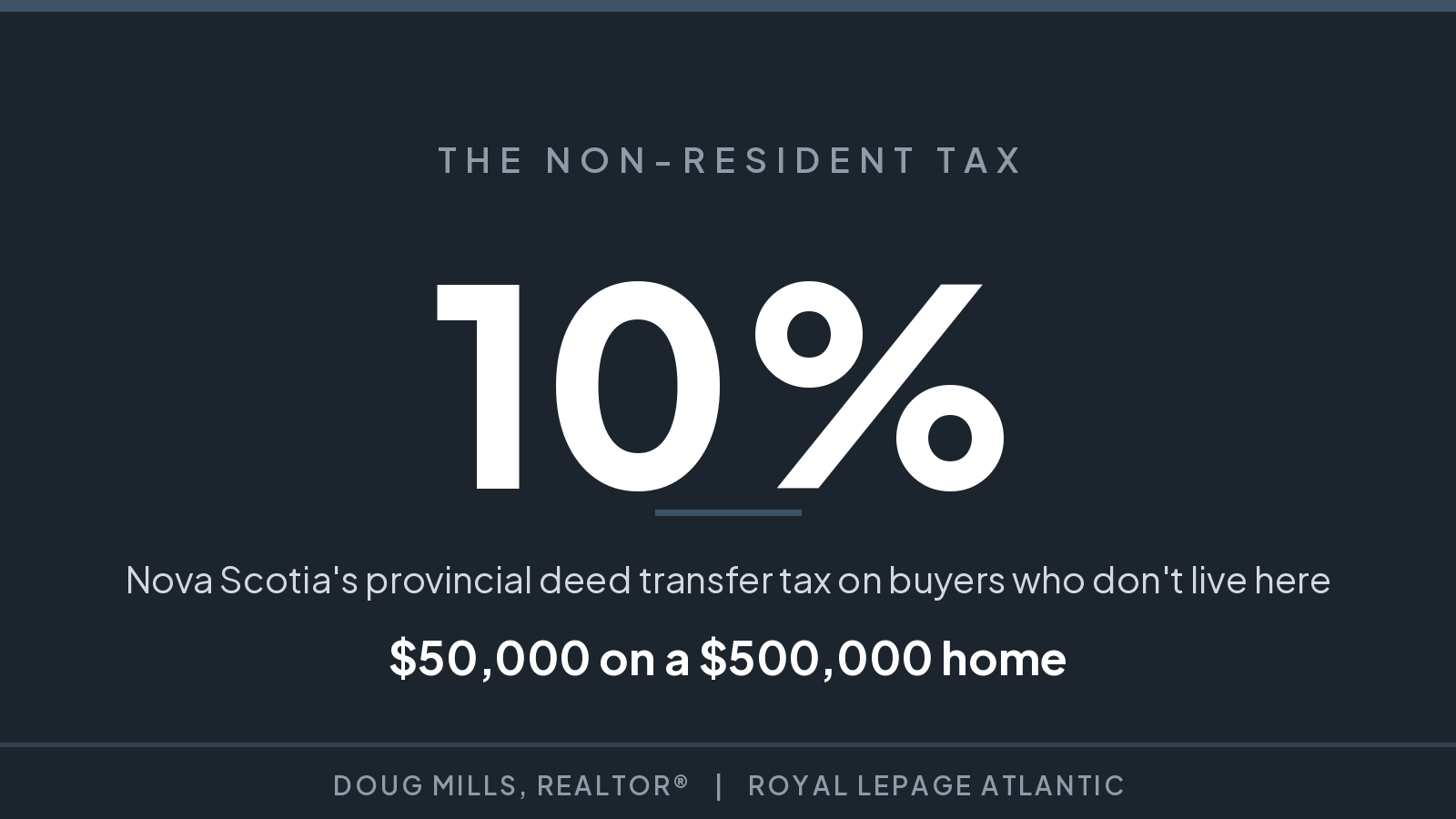
Here is the one that surprises buyers. Nova Scotia charges a Non-Resident Provincial Deed Transfer Tax, and on April 1, 2025 it doubled from 5% to 10%.
It is 10% of the purchase price, or the assessed value if that is higher, and it is due at closing unless you qualify for the move-here exemption I explain below. And “non-resident” here does not mean foreign. It means anyone who is not a resident of Nova Scotia. A buyer from another Canadian province is a non-resident for this tax, same as a buyer from another country. On a $500,000 home, that is a $50,000 line you did not have a week ago.
That number stops a lot of people cold. It should not, because there is a door most South Shore buyers walk straight through.
The one question that decides your tax bill
Updated 10 August 2026. Nova Scotia changed how this tax is administered on 7 August 2026. The 10% rate did not move. The timing did. You now have one year rather than six months to file your proof of residency, the window to apply for a refund went from one year to two, property willed to a non-resident after a death is now exempt, and a refund can be paid to your lawyer. The new timelines apply to property transfers on or after 7 August 2026.
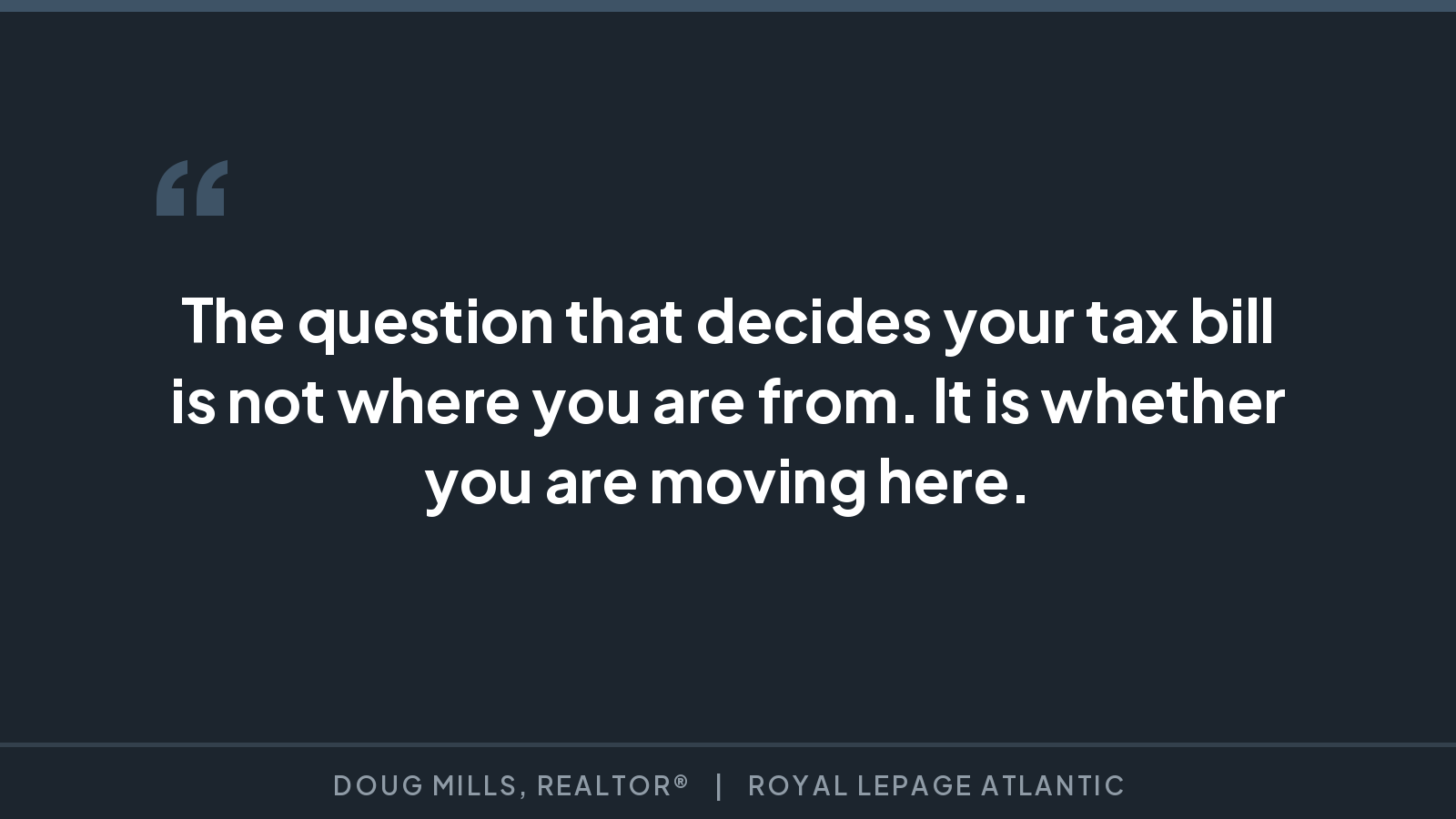
The provincial tax has an exemption, and the timing is where everyone, including plenty of agents, gets confused. So here is exactly how it works, step by step.
You do not pay the 10% at closing if you are moving here. At closing you sign a declaration that you intend to become a Nova Scotia resident. Based on that, the tax is not collected that day. Nothing extra comes out of your closing.
Then the clock starts. You have one year from your closing date to send the province proof that you live here now. That window used to be six months. Nova Scotia extended it on 7 August 2026, and the longer window applies to closings on or after that date. Make the move and file the proof, and that is the end of it. You never pay the 10%.
Miss it, and the bill comes back. If the window passes and Nova Scotia is still not your home, say the place stayed a cottage or the move fell through, the province charges you the full 10% backdated to your closing day, with interest from that day, and possibly a penalty. One extension is available if something genuinely outside your control got in the way.
So the exemption is not a reward for saying you will move. It is a test of whether you did. Plant roots here and you sail through it. Keep a second home and your life somewhere else, and you should plan on the 10%.
It is also counted per person. If you are moving and your partner is staying behind, only the one who does not become a resident is taxed, on their share of the home.
The deed transfer tax everyone pays
Separate from all of that, every buyer in Nova Scotia pays a municipal deed transfer tax, set by the town or municipality. On the South Shore it is 1.5% in most places. Bridgewater, the Town of Lunenburg, Mahone Bay, Chester, and the Region of Queens, which covers Liverpool and Port Medway, all sit at 1.5%. The rural Municipality of the District of Lunenburg is a touch lower at 1.25%. On that same $500,000 home, the municipal tax is $7,500.
What it adds up to
Put it together on a $500,000 purchase. If you are moving here, your land transfer cost is the municipal tax alone, about $7,500, plus the usual legal, title, and adjustment costs your lawyer will walk you through. If you are staying a non-resident, add the 10% provincial tax on top, and the same purchase carries roughly $57,500 in transfer taxes before you turn the key.
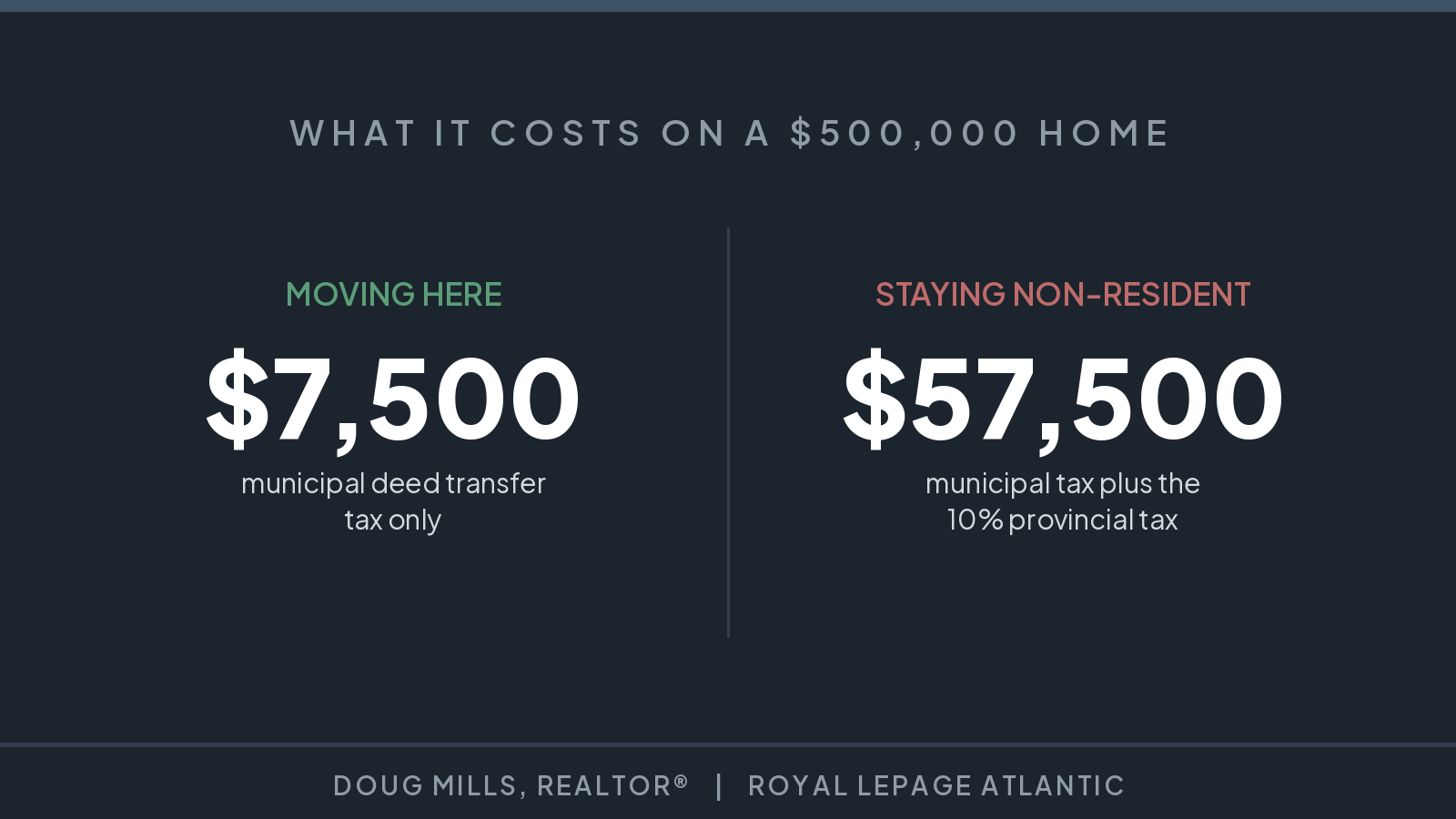
That is a $50,000 swing on one decision. It is the single biggest number in a South Shore purchase from away, and it turns entirely on whether you are planting roots or keeping a getaway. Your lawyer confirms the residency piece and files it. My job is to make sure you know it is coming long before you are sitting at a closing table.
Coming up this fall
Later this year I am heading further down the shore. Some of the best value and most character on this coast sits in the spots that do not make the postcards: Bridgewater, Liverpool, and Port Medway. Each one is getting the same honest, town-by-town treatment in the months ahead.
Common questions about buying the South Shore from away
Does the foreign buyer ban apply on the South Shore?
Almost nowhere. Mahone Bay, Lunenburg, Chester, Bridgewater, Liverpool, and the rural coast in between all sit outside it. The one exception is the far eastern edge that falls inside Halifax Regional Municipality, and so counts as part of the Halifax zone: St. Margarets Bay, Peggy’s Cove, and the small section of Hubbards on the HRM side of the county line. Cross into Lunenburg County and you are clear.
I am Canadian but live in another province. Does the ban affect me?
No. The federal ban is about citizenship, not which province you live in. You can buy anywhere on the shore.
What is Nova Scotia’s non-resident tax?
A 10% provincial deed transfer tax on buyers who are not residents of Nova Scotia. It doubled from 5% on April 1, 2025, and applies to buyers from other provinces as well as other countries.
Can I avoid the 10%?
Yes, if you genuinely move here. You sign a declaration at closing, and for closings on or after 7 August 2026 you have a year to file your proof of residency. That window used to be six months. Make the move and you never pay it. Miss the window and the full 10% comes back, backdated to closing, with interest.
Does every buyer pay a deed transfer tax?
Yes. A municipal deed transfer tax, about 1.5% on most of the South Shore, applies to every buyer regardless of where they live.
Have a question about your specific situation?
Email or call/text anytime. I read everything myself.
doug@dougmills.ca +1 902.410.3740
Written by Doug Mills, REALTOR® with Royal LePage Atlantic. I help out-of-province and overseas buyers purchase along Nova Scotia’s South Shore.
