
Hubbards, Chester, Mahone Bay or Lunenburg: Which South Shore Town Is Actually Right for You?

Most of the out-of-province buyers I work with start the same way. They have already decided on the South Shore. They have seen the photos, they have watched the videos, and they ask me to send them everything for sale here. Then the list comes back and runs from a $320,000 fixer to a $2 million harbourfront estate, with the two properties forty minutes apart.
The South Shore is not one place. Follow the coast down from Halifax and you pass through Hubbards, then Chester, then Mahone Bay, then Lunenburg, each one roughly twenty minutes from the next. Same coastline, four genuinely different towns. Each one would hand you a different day, a different budget, and different neighbours.
I live on St. Margarets Bay and work out of Mahone Bay, so I drive this coast most days. Here is the straight version of how the four towns differ, so your buying trip is spent looking at the right one instead of all of them.
Hubbards: the one closest to Halifax
Hubbards sits at the eastern edge of the South Shore, about 45 minutes from Halifax. That drive is the whole story. If someone in your household still commutes, or you want easy access to the city for medical appointments, the airport, or family, Hubbards keeps that simple in a way the other three towns do not.
It also tends to be the most affordable entry point of the four. You are closer to the Halifax commuter belt, so more of what you see falls in the $350,000 to $500,000 range, and more of it is ordinary family housing rather than heritage homes or trophy waterfront.
The trade is that Hubbards feels less like a destination and more like a place people simply live. The Hubbards Barn and its Sunday farmers market are the social centre. Queensland Beach is minutes away. You will not find the dense, walkable main street that Mahone Bay and Lunenburg have. For plenty of buyers, that is exactly the appeal.
Who it fits: buyers who need Halifax within reach, want more house for the money, and do not need a postcard main street out the front door.
Mahone Bay: the walkable one
My office is on Main Street in Mahone Bay, so weigh this section with that in mind. The three churches lined up along the water are the image most people hold in their head when they picture Nova Scotia. What that photo does not show is that the town behind it works year-round.
Main Street is genuinely walkable. You can get coffee, groceries, a meal, a haircut, and a gift without moving your car, and the independent shops are open in February, not only in July. The Wooden Boat Festival in summer and the Father Christmas Festival in winter keep a real community calendar running through the whole year.
Pricing sits in the mid-market for the area. A solid in-town home is reachable without a waterfront budget. The closer you get to the water, the faster that changes.
Who it fits: buyers who want to live in a town rather than near one. People who value walkability, a small-business and arts community, and a place that does not empty out after Labour Day.
“The South Shore isn’t one market. It’s four small towns with four different answers to the same question.”
Chester: the one with the sailing money
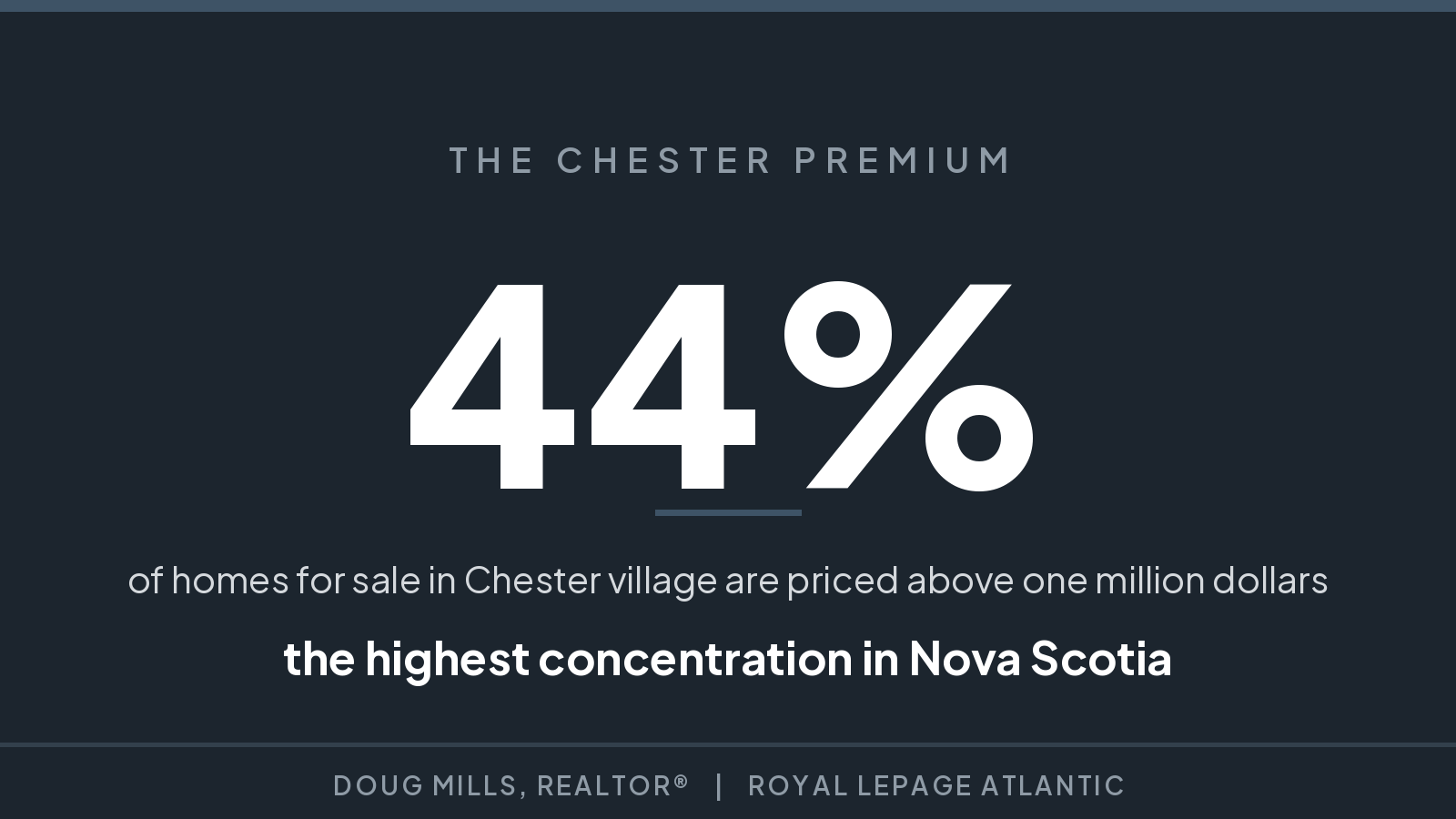
Chester is the outlier of the four, and the numbers say so plainly. It has the highest concentration of high-end listings in the province. Recent data put 44% of the homes for sale in Chester village above one million dollars.
Chester has been a summer-resort town for more than a century. The yacht club, the golf course, Chester Race Week (one of the largest keelboat regattas in the country), and a long line of seasonal residents from away give it a rhythm the other towns do not share. In July and August it is lively. In January it is quiet, and a real share of the houses around you may sit dark for the season.
None of that is a criticism. If you want sailing, a strong summer social scene, and the prestige that comes with the address, Chester delivers it better than anywhere else on the shore. You just want to walk in understanding the seasonal pattern and the price floor.
Who it fits: buyers drawn to the harbour and sailing life, comfortable with a higher entry price, and content with a town that runs at two very different speeds across the year.
Lunenburg: the historic one
Lunenburg is the most recognized of the four. The Old Town is a UNESCO World Heritage Site, the Bluenose II is based here, and the colourful waterfront pulls steady tourism right through the season. It has the deepest restaurant scene on the shore and a real cultural draw.
Two things are worth knowing before you fall for it. First, summer brings genuine tourist traffic. That is wonderful if you want energy at your doorstep and less so if you were picturing quiet. Second, much of the Old Town housing stock is historic, and properties inside the heritage district come with conservation guidelines that shape what you can change and how. An older home also carries an older home’s maintenance. Budget for it.
Pricing swings widely depending on whether you are in the Old Town itself, in the newer areas above the hill, or out in the surrounding countryside.
Who it fits: buyers who want history, culture, and a lively town, and who either want a heritage property and understand the commitment, or want to be near all of it without owning the upkeep.
Don’t skip the places in between
Most people get to the South Shore on Highway 103, the fast divided road. The route worth knowing is the old Highway 3, the Lighthouse Route, which hugs the shore and threads the four towns together. The towns get the attention. The stretches between them are where a lot of the quiet good buying happens.
On the Aspotogan Peninsula, the headland between St. Margarets Bay and Chester, you find cove communities like Bayswater, Blandford, and Northwest Cove, plus some of the best beaches on the shore. Around Chester there is Chester Basin and Western Shore, home to Oak Island and its treasure legend. Between Mahone Bay and Lunenburg sit quiet spots like Indian Point and Mader’s Cove, and just past Lunenburg is Blue Rocks, a working fishing hamlet that photographs like nowhere else.
If your priority is land, water frontage, or value rather than a walk-to-Main-Street lifestyle, these in-between communities often give you more for your money than the town centres. They rarely surface when someone searches by town name, which is exactly why they reward a local set of eyes.
So how do you actually choose?
Set the listing photos aside for a minute. These towns photograph more alike than they live.
Start with two questions. How often will you genuinely need Halifax? And do you want a town that stays busy year-round, or one that breathes with the seasons? Those two answers usually rule out at least one town right away, often two.
Then read the calendar honestly. The South Shore market is seasonal in a way that catches people off guard. Last year the region’s average monthly sale price ran from about $339,000 in January up to roughly $528,000 in September. Provincewide, homes are now taking around 50 days to sell and months of supply has climbed close to the balanced range, so you have room to choose well rather than rush. A February visit and a September visit can leave you with very different impressions of the same town, and very different competition for the house you want.
The smartest move for an out-of-province buyer is to spend a full day in two or three of these towns before you narrow the search, ideally outside peak summer. I am glad to map that out with you, point you toward the right streets, and tell you which town I would be looking at based on what you have told me you want.
Common questions about buying on the South Shore
Which South Shore town is closest to Halifax?
Hubbards, at the eastern edge of the shore, about 45 minutes from Halifax, and typically the most affordable entry point of the four.
Which South Shore town is the most expensive?
Chester. Recent data put 44% of the homes for sale in Chester village above one million dollars, the highest concentration in the province.
Which South Shore town is the most walkable?
Mahone Bay. Main Street is genuinely walkable, and the independent shops and community calendar run year-round, not only in summer.
Is Lunenburg a good place to buy?
It offers history, culture, and a lively town. Just know that summer brings real tourist traffic, and Old Town heritage properties come with conservation guidelines and an older home’s upkeep.
When should I visit to compare the towns?
Spend a full day in two or three of them before you narrow your search, ideally outside peak summer, since a February visit and a September visit leave very different impressions. When you are weighing what it will cost, read what it really costs to buy from away, or browse the South Shore communities.
Have a question about your specific situation?
Email or call/text anytime. I read everything myself.
doug@dougmills.ca · +1 902.410.3740
Written by Doug Mills, REALTOR® with Royal LePage Atlantic. I help out-of-province and overseas buyers purchase along Nova Scotia’s South Shore.
