
Year One in a South Shore House: The Bills That Show Up After Closing
Last month I wrote about what it costs to buy here from away: the deed transfer taxes, the 10% that catches non-residents, and the move-here exemption that makes it disappear. Those are one day numbers. You pay them at a closing table and they are behind you.
This post is about the twelve months after that day. The real cost of owning a home on Nova Scotia’s South Shore is not the mortgage payment. It is a handful of line items that almost nobody from away has budgeted for, because none of them work the way they do where you are coming from. I have watched buyers absorb every one of these after the fact. It is a better conversation to have now.
Why is my property tax higher than my neighbour’s?
This is the one that surprises people most, and it is worth understanding before you shop, not after.
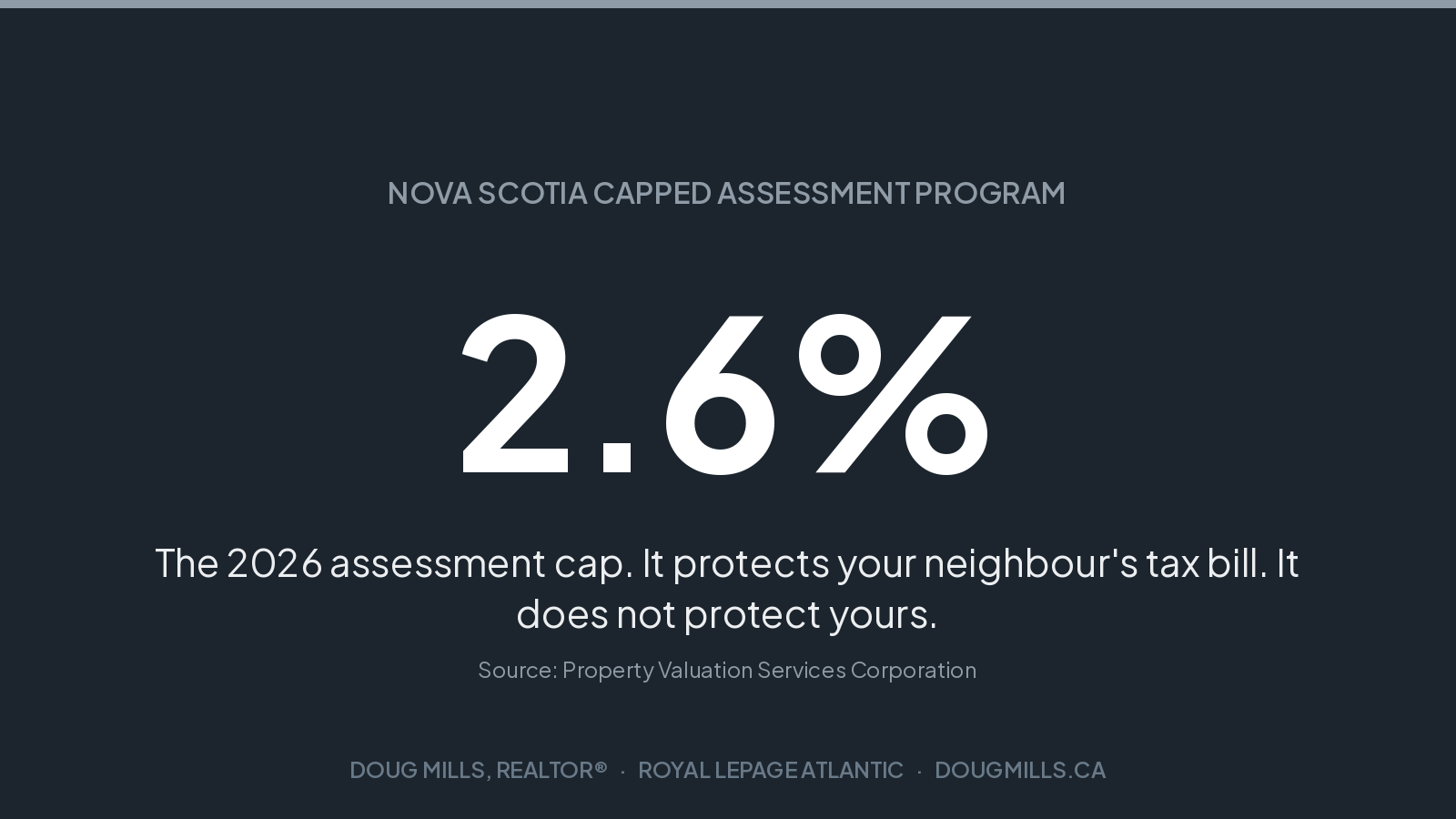
Nova Scotia runs a Capped Assessment Program. It limits how fast the taxable assessment on a home can rise each year, no matter what the market does. For 2026 that cap is 2.6%, tied to the provincial Consumer Price Index. Someone who bought a house in Lunenburg in 2011 has had their assessment creeping up by small single digits every year since, while the market value of that house has done something very different.
Two things happen when that house sells. The cap comes off for the year following the sale, so the assessment resets toward what the property is actually worth now. And the new owner only gets back under the cap if the home is at least 50% owned by a Nova Scotia resident. A home majority owned by out-of-province residents is not eligible at all.
Read that twice if you are buying from away and keeping your residency elsewhere. It is not a penalty and it is not aimed at you. It is just a program you sit outside of. Your assessment tracks market value, permanently, while the identical house next door stays capped.
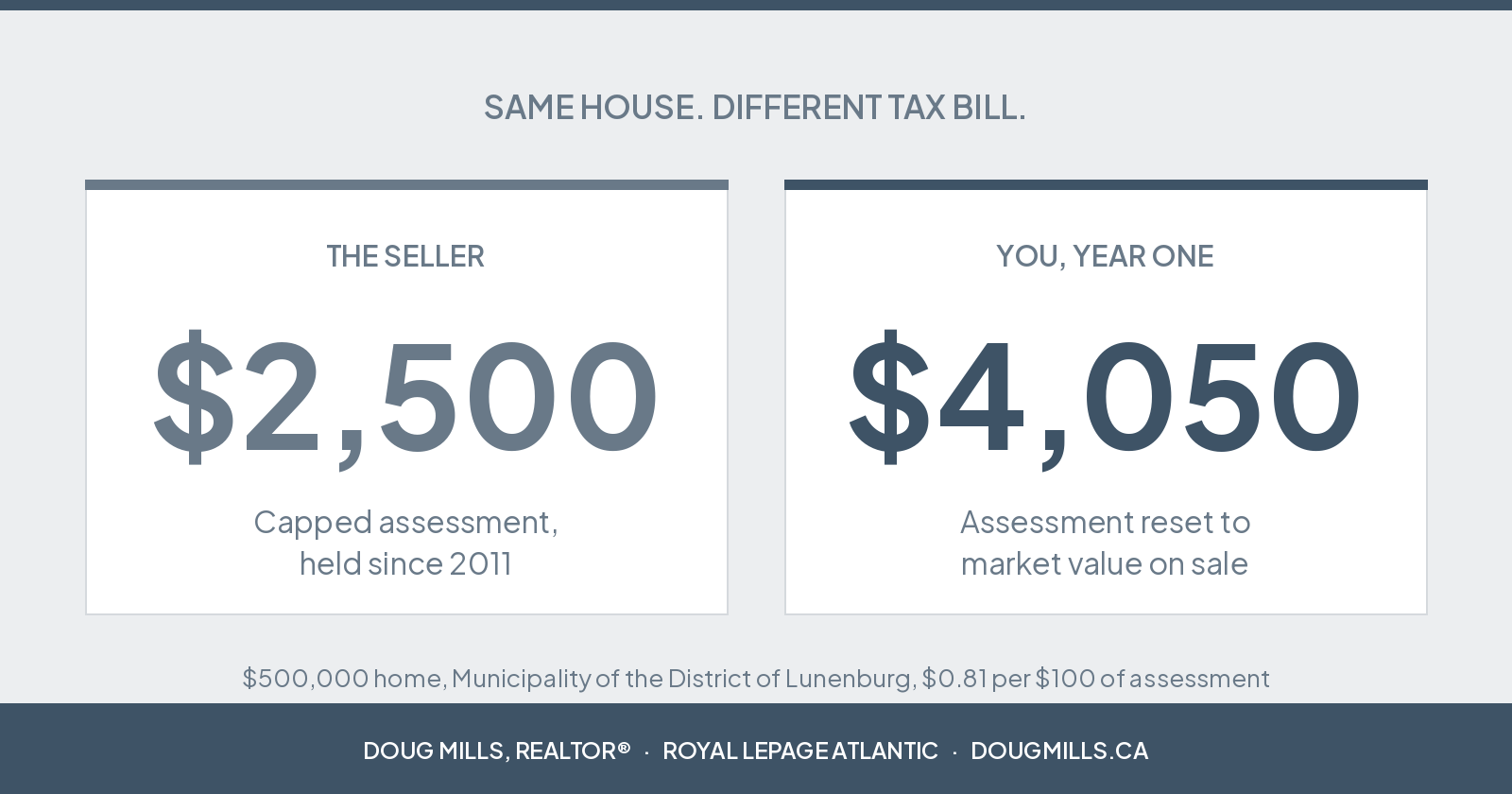
So the number to plan around is not the seller’s current tax bill. It is the tax bill on full market value. In the Municipality of the District of Lunenburg the residential rate posted for the year ending March 2026 is $0.81 per $100 of assessment, before area rates for fire and streetlights. On a $500,000 assessment that is about $4,050 a year. If the seller’s capped assessment was sitting at $310,000, they were paying about $2,500. Same house, same street, roughly $1,500 apart.
What will it actually cost to heat?
A lot of South Shore houses still run on oil. Some run on oil plus a wood stove, which is a genuinely good combination in a place that loses power in a nor’easter. Plenty have added heat pumps.
Nova Scotia Power’s residential rate is 19.128 cents per kilowatt hour plus a $20.08 monthly base charge as of May 1, 2026. Electricity here is not cheap, and it went up again this year. That matters because a heat pump is an electric appliance, and the “just put in a heat pump” advice you will get online was written for provinces with cheaper power.
The honest version: a modern cold climate heat pump still beats oil on operating cost here, and it gives you air conditioning in August, which nobody used to want and everybody now does. But it is not free heat, and in an older uninsulated farmhouse it will not carry the whole load in February. The house needs a backup. Ask what the current owner actually spends, in dollars, for a full winter. Not what they think it costs. What the bills say.
Why does insurance kill more South Shore deals than inspections?
This is the item I would put at the top of the list if I could only warn you about one.
Insurance on a coastal Nova Scotia home is not a formality you sort out the week before closing. It is a condition you should be testing early, because insurers here ask hard questions and some houses come back uninsurable at any sensible price.
The three that come up over and over:
Oil tanks. Insurers set hard age limits, and they are shorter than people expect. Steel tanks are often only covered to ten years, fibreglass to twenty. A twelve year old steel tank in a basement can mean no policy until it is replaced, and replacement is on someone’s dime before closing.
Wood stoves. If there is one, expect the insurer to require a WETT certified inspection confirming it was installed to code. A beautiful old stove that nobody has papers for is a problem to solve, not a feature.
The rest of the house. Roof age, knob and tube or fuse panels, Poly-B or Kitec plumbing. Any one of these can turn a routine policy into a special quote or a decline.
Averages are not much use here. Nova Scotia’s average home premium is around $782 a year, but a 140 year old wood frame house a hundred metres from open water with a wood stove is not an average home. Get a real quote on the real address before your conditions are up.
What do well and septic really cost?
Most of the coast outside the town cores is on a drilled well and a septic field. If you have only ever owned on municipal services, this is a new category of responsibility rather than a new bill. The costs are manageable. The surprises are not.
At purchase, budget for the testing. On the South Shore a home buyer’s water quality package runs about $165 plus HST on a seven business day turnaround, or $255 for three days when you are tight on conditions. A well recovery and flow test, which tells you whether the well actually produces enough water for the house, is about $300. A full septic inspection is about $350. Book all three. A house that looks perfect can have a well that runs dry every August, and you will not learn that from a standard home inspection.
After purchase, the ongoing costs are a pump out every few years, occasional water testing, and replacing a UV or iron filter system if there is one. None of it is dramatic. What is dramatic is a failed septic field, which is a five figure repair, and the only defence against it is the inspection you did or did not do at the front end.
The costs that only exist out here
A few line items that never come up in a city purchase and come up constantly on this coast.
Private roads. A meaningful number of waterfront and rural properties on the shore sit on roads the municipality does not own, plough or maintain. That means a private plough contract in winter and a share of gravel and grading in summer, split among the households on the road. Ask who ploughs and what it costs before you fall for the view.
Salt air. It is hard on everything. Exterior paint, window hardware, deck fasteners, roofing, metal railings, outboard motors. A house in Mahone Bay, Lunenburg, Chester or Liverpool needs more frequent exterior maintenance than the same house twenty kilometres inland. Budget for painting on a shorter cycle than you are used to.
Distance. Bridgewater is the shopping centre for most of the shore. If you are buying in Port Medway or the back roads of Chester, factor in what a weekly drive actually costs you in fuel and time, and check what the internet options are at that civic address before you assume you can work from there.
Putting a real year together
Take a $500,000 home in the rural Municipality of the District of Lunenburg, on a well and septic, bought by someone keeping their residency out of province.
Property tax on a reset market assessment lands near $4,050 before area rates. Insurance on an older coastal house, realistically $1,500 to $2,500 rather than the provincial average. Power with a heat pump doing most of the heating, and the first $241 a year is base charge before a single kilowatt hour. Well and septic upkeep averaged out, a few hundred a year. Exterior maintenance on a shorter cycle than you are used to.
None of these numbers are frightening on their own. Added up, they are usually a few thousand dollars a year more than the buyer had pencilled in, and the property tax reset is almost always the biggest single gap between what the seller was paying and what the new owner will pay.
That is the whole point of writing this in August rather than at a closing table in November. Ask for the actual bills. Oil delivery receipts, twelve months of power bills, the current tax bill and the assessment notice behind it, the insurance policy, the well and septic history. A seller who has them will hand them over. A seller who cannot find any of them has told you something too.
Common questions about the cost of owning on the South Shore
Will my property tax go up after I buy?
Usually, yes. Nova Scotia’s Capped Assessment Program limits annual assessment increases, and the cap comes off for the year following a sale to someone outside the family. Your assessment resets toward market value, so the bill is often well above what the seller was paying on the same house.
Can I get the assessment cap as an out-of-province owner?
No. The program requires the property to be at least 50% owned by a Nova Scotia resident. A home majority owned by out-of-province residents is not eligible. A non-resident can hold up to 49% of an eligible property.
How much is the 2026 cap?
2.6%, set from the Nova Scotia Consumer Price Index. That is the most a capped assessment can rise this year, regardless of what the market did.
Is a heat pump enough to heat a South Shore house?
In a well insulated house, usually. In an older uninsulated one, plan on a backup for the coldest stretches. Nova Scotia Power charges 19.128 cents per kilowatt hour plus a $20.08 monthly base charge as of May 2026, so run the numbers on the actual house rather than a general rule.
What should I test before closing on a rural property?
Water quality, well recovery and flow, and a full septic inspection. On the South Shore those run roughly $165, $300 and $350 respectively. A standard home inspection does not cover any of the three.
Does the 10% non-resident tax affect what I pay every year?
No. The non-resident deed transfer tax is a one time charge at closing. The costs in this post are the ongoing ones, and the assessment cap is the one that compounds year after year.
Have a question about your specific situation?
Email or call/text anytime. I read everything myself.
+1 902.410.3740
Written by Doug Mills, REALTOR® with Royal LePage Atlantic. I help out-of-province and overseas buyers purchase along Nova Scotia’s South Shore.
